 Add to Chrome
 Add to Firefox
 Add to Edge
When Preference Labels Fall Short: Aligning Diffusion Models from Real Data
May 19, 2026
Preference alignment aims to guide generative models by learning from comparisons between preferred and non-preferred samples. In practice, most existing approaches rely on preference pairs constructed from model-generated images. Such supervision is inherently relative and can be ambiguous when both samples exhibit artifacts or limited visual quality, making it difficult to infer what constitutes a truly desirable output. In this work, we investigate whether real data can serve as an alternative source of supervision for preference alignment. We adopt a data-centric perspective and study a curation strategy that treats real images as reference points and constructs preference signals by contrasting them with generated or perturbed samples, without requiring manually annotated preference pairs. Through empirical analysis, we show that real-data-based supervision provides effective guidance for aligning diffusion models and achieves performance comparable to existing preference-based methods. Our results suggest that real data offers a practical and complementary source of supervision for preference alignment and highlight directions of label-efficient alignment strategies. Code and models are available at https://cwyxx.github.io/RealAlign.

Robust Conditional Conformal Prediction via Branched Normalizing Flow
May 03, 2026Conformal prediction (CP) constructs prediction sets with marginal coverage guarantees under the assumption that the calibration and test distributions are identical. However, under distribution shift, existing approaches primarily align marginal conformal score distributions, which is sufficient to preserve marginal coverage but does not control the conditional coverage error at individual test inputs. As a consequence, CP can remain unreliable in regions where the conditional score distributions are mismatched. In this work, we bound the conditional invalidity of CP under distribution shift in terms of the Wasserstein distance between the calibration and test distributions. This result highlights the role of invertible transport in mitigating conditional coverage degradation. Motivated by this insight, we introduce Branched Normalizing Flow (BNF), a two-branch architecture that normalizes a test input to the calibration distribution and transforms the prediction set of the normalized input back to the test distribution while preserving conditional guarantees. Empirically, BNF consistently improves conditional coverage robustness on nine datasets across a wide range of confidence levels.
Unveiling Perceptual Artifacts: A Fine-Grained Benchmark for Interpretable AI-Generated Image Detection
Jan 27, 2026Current AI-Generated Image (AIGI) detection approaches predominantly rely on binary classification to distinguish real from synthetic images, often lacking interpretable or convincing evidence to substantiate their decisions. This limitation stems from existing AIGI detection benchmarks, which, despite featuring a broad collection of synthetic images, remain restricted in their coverage of artifact diversity and lack detailed, localized annotations. To bridge this gap, we introduce a fine-grained benchmark towards eXplainable AI-Generated image Detection, named X-AIGD, which provides pixel-level, categorized annotations of perceptual artifacts, spanning low-level distortions, high-level semantics, and cognitive-level counterfactuals. These comprehensive annotations facilitate fine-grained interpretability evaluation and deeper insight into model decision-making processes. Our extensive investigation using X-AIGD provides several key insights: (1) Existing AIGI detectors demonstrate negligible reliance on perceptual artifacts, even at the most basic distortion level. (2) While AIGI detectors can be trained to identify specific artifacts, they still substantially base their judgment on uninterpretable features. (3) Explicitly aligning model attention with artifact regions can increase the interpretability and generalization of detectors. The data and code are available at: https://github.com/Coxy7/X-AIGD.
Convolutional Sparse Coding for Compressed Sensing CT Reconstruction
Mar 20, 2019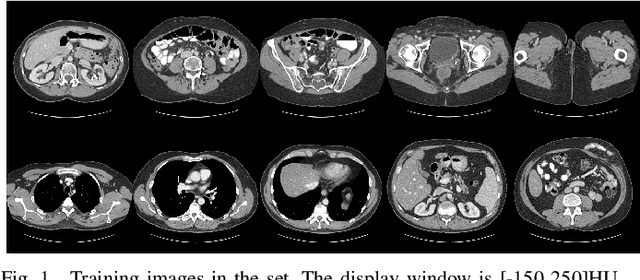
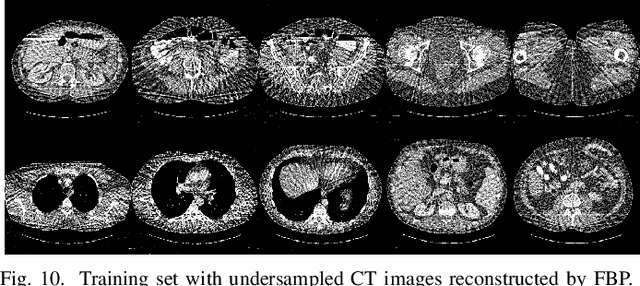
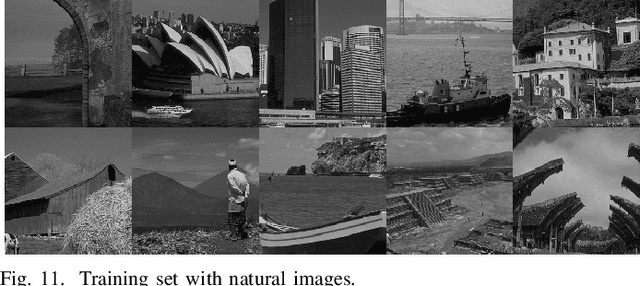
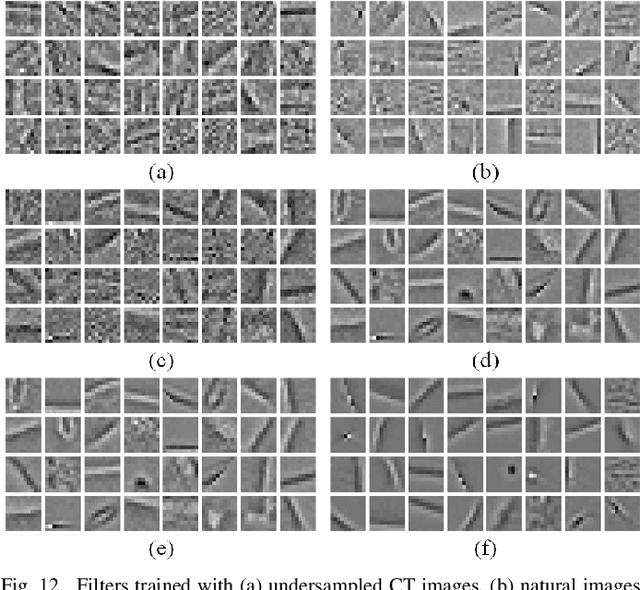
Over the past few years, dictionary learning (DL)-based methods have been successfully used in various image reconstruction problems. However, traditional DL-based computed tomography (CT) reconstruction methods are patch-based and ignore the consistency of pixels in overlapped patches. In addition, the features learned by these methods always contain shifted versions of the same features. In recent years, convolutional sparse coding (CSC) has been developed to address these problems. In this paper, inspired by several successful applications of CSC in the field of signal processing, we explore the potential of CSC in sparse-view CT reconstruction. By directly working on the whole image, without the necessity of dividing the image into overlapped patches in DL-based methods, the proposed methods can maintain more details and avoid artifacts caused by patch aggregation. With predetermined filters, an alternating scheme is developed to optimize the objective function. Extensive experiments with simulated and real CT data were performed to validate the effectiveness of the proposed methods. Qualitative and quantitative results demonstrate that the proposed methods achieve better performance than several existing state-of-the-art methods.
Optimal control with reset-renewable resources
Sep 27, 2014
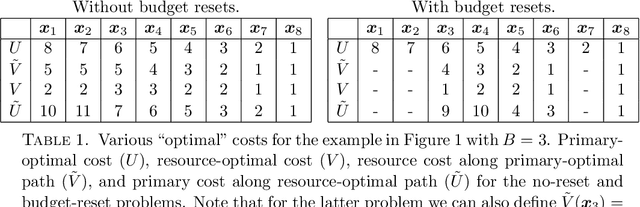
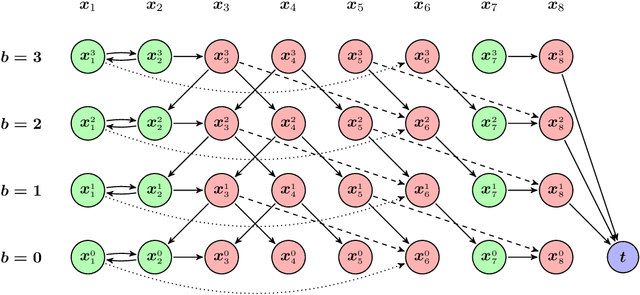
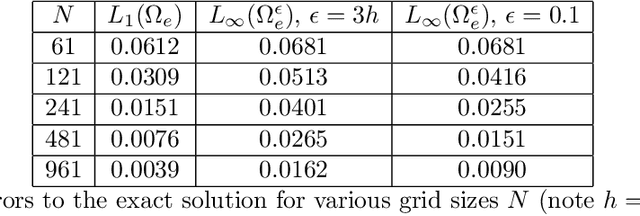
We consider both discrete and continuous control problems constrained by a fixed budget of some resource, which may be renewed upon entering a preferred subset of the state space. In the discrete case, we consider both deterministic and stochastic shortest path problems with full budget resets in all preferred nodes. In the continuous case, we derive augmented PDEs of optimal control, which are then solved numerically on the extended state space with a full/instantaneous budget reset on the preferred subset. We introduce an iterative algorithm for solving these problems efficiently. The method's performance is demonstrated on a range of computational examples, including the optimal path planning with constraints on prolonged visibility by a static enemy observer. In addition, we also develop an algorithm that works on the original state space to solve a related but simpler problem: finding the subsets of the domain "reachable-within-the-budget". This manuscript is an extended version of the paper accepted for publication by SIAM J. on Control and Optimization. In the journal version, Section 3 and the Appendix were omitted due to space limitations.